Examples
Pre-defined examples are available in the causalinf package for some
methods. They can be accessed with the function examples(). If no
argument is provided, it lists all examples available for the method.
The general structure is:
For instance, to list the examples available for the Graphical Causal Models (GCM) submodule, use:
List of available examples:
--------------------------
1. Not identifiable
2. One confounder
3. Two confounders
4. Front-door
5. IV with 1 instrument
6. IV with 3 instruments
7. SoO, IV, and do identified with 1 confounder
8. Mediation: 2 sequential 1 confounder
9. Pearl Example 1.1 (a)
10. Pearl Example 1.1 (b)
11. Pearl Example 1.2
12. Pearl Example 1.3 (a)
13. Pearl Example 1.3 (b)
14. Pearl Example 3.1
15. Pearl Example 3.4
16. Pearl Example 3.5

Usage: examples(which='<example name>')
Example: G = examples(which='Pearl Example 3.5')
Note: To print the associated DAG of each example, use examples(print_DAG=True)
As described in the last lines of the output above, to use one of the examples, say Pearl Example 1.1, which is based on example 1.1 from Pearl (2009), run:
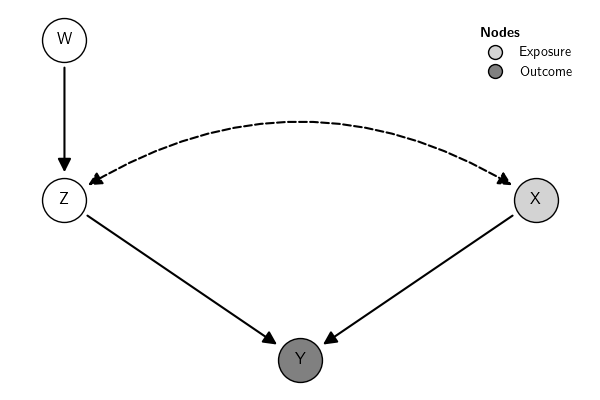
See Simulate Data to generate synthetic data from the graph.
References
- Pearl, J. (2009). Causality: Models, Reasoning and Inference. : Cambridge Univ Press.